CHRIS HEIRWEGH
CHRIS HEIRWEGH
Research scientist, investigating X-ray fluorescence spectroscopy analytical methods, fundamental physics and space instrumentation development

BIO
I have spent my career researching fundamental physics and new methods to make accurate quantitative analysis of materials possible when using X-ray fluorescence spectroscopy (XRS) techniques. My exposure to this field began as a masters student at McMaster University in the Department of Medical Physics in Hamilton, Canada. There I assessed the feasibility of quantifying bone strontium levels, in vivo, using XRS as a means to monitor persons supplementing strontium medication to treat osteoporosis. These efforts demonstrated that corrections for X-ray absorption in soft-tissue could be applied with help from high-frequency ultrasound imaging but that tendon vs bone surfaces had to be carefully distinguished in interpretation of images.
Later, to enhance my understanding of the fundamental physics that give rise to XRS techniques, I joined the Department of Physics at the University of Guelph in Guelph, Canada. My doctoral work there involved several projects aimed at improving the accuracy of analyzing low atomic number element-oxide major constituents in geological materials, using particle-induced X-ray emission (PIXE) analysis. This work I conducted, while a member of the Guelph-PIXE Group (GPG), led to increased knowledge of how to fit non-Gaussian features in mono-chromatic spectra, a new measurement of the K-shell fluorescence yield for Si, an improved understanding of the accuracy of certain X-ray attenuation mass-attenuation coefficient (MAC) databases used to quantify Na, Mg, Al and Si in geological materials, and, an assessment of the accuracy realized from a PIXE microprobe calibrated using a hybrid MAC database.
During my first postdoctoral fellowship, also within the GPG, I re-directed my efforts to enhance fitting treatments applied to spectra returned from the Alpha-Particle X-ray Spectrometers (APXS) mounted on NASA's Spirit, Opportunity and Curiosity Mars rovers. This work led to discovery that slight non-linearities in the energy-channel calibration of APXS detection systems were negatively impacting fits to spectra recorded form measured targets. High-resolution measurement of light element X-ray lines, performed through partnerships with members of the Institut Jožef Stefan (IJS), Slovenia and Institut Ruđer Bošković (IRB), Croatia, allowed us to disentangle contributions to non-linearity as the result of two effects: X-ray multi-vacancy induced X-ray satellites and pure signal-processing effects. From this effort, corrections to the fitting treatment applied to spectra resulted in in significantly improved peak fitting quality.
In 2016, I joined the Jet Propulsion Laboratory, California Institute of Technology in Pasadena, California, as a Caltech Postdoctoral Fellow, to support the preparation of PIXL, the Planetary Instrument for X-ray Lithochemistry. PIXL is the most recent XRS that was selected by NASA for installation on the Mars 2020 Perseverance rover. My research focused on developing the calibration protocols to make focused-beam XRS elemental quantification using PIXL possible. I also served as the principle consultant and alpha tester for the development of PIXL’s Quantitative XRS software (PIQUANT). I have held the position of JPL Research Scientist in JPL’s Planetary Science Section since 2018. In this time, I have served as an XRS subject-matter expert for the engineering integration and testing (I&T) phase during PIXL’s assembly. I also supported the completion of PIXL’s elemental calibration and for the past three years have managed PIXL’s team of science payload uplink and downlink leads who support Perseverance operations.
My recent research efforts include studies that might enhance knowledge of PIXL’s elemental accuracy and the development of concepts for new space-bound in situ XRS instruments.
PROJECTS
Recent project work focuses on developing the XRF analytical capabilities of the Planetary Instrument for X-ray Lithochemistry (PIXL). Several contributions in earlier work included: enhancing the analysis of data returned from the Mars Science Laboratory (Curiosity Rover) alpha-particle X-ray Spectrometer, assessing the fundamental physics of X-ray emission from light elements using particle induced X-ray emission (PIXE) analysis as well as assessing the feasibility of quantifying strontium in vivo using XRF analysis.

PIXL Elemental Calibration
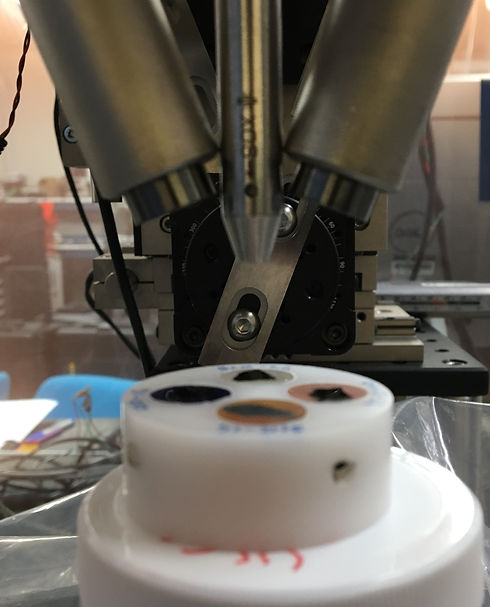
Let the development of PIXL's elemental calibration procedure, target selection and analysis algorithms. Elemental calibration makes quantification of unknown rocks and regolith targets measured by Perseverance Rover possible.
Image source: Allwood et al., Space Sci. Rev. 134 (2020) 1 - 132.

PIQUANT Software Design Consultant
Worked as primary design consultant and alpha-tester for the PIXL XRF Quantification (PIQUANT) software used to process data returned by the PIXL instrument mounted on the arm of NASA's Perseverance Rover
CONTACT
Jet Propulsion Laboratory, California Institute of Technology
